A Company’s Economic Success Depends on the Quality of Its Management
A study of over 700 manufacturing companies in France, Germany, the United Kingdom, and the United States has confirmed the link between good management and superior performance. Companies that successfully implemented a key set of proven management practices—setting targets, monitoring performance, reinforcing shop-floor operations, and nurturing talent—performed on average better than competitors that used these practices inconsistently. Advanced management practices are not only associated with financial returns for investors but also with a positive work-life balance for employees and managers. Although government policies and the industrial sector in which companies operate can affect their productivity and financial strength, this study showed that managerial decisions have a greater impact.
The Vital Role of Management in Company Success and the Impact of Managerial Decisions on Organizational Performance
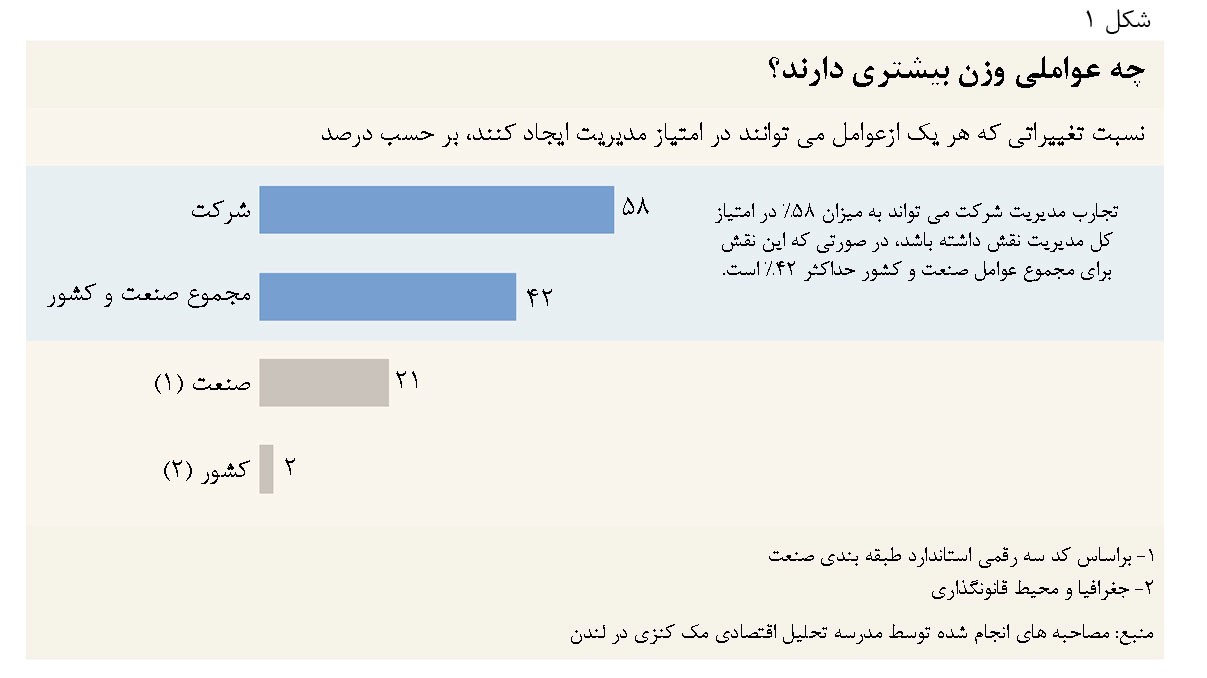
There is a common and popular hypothesis that if companies perform well, they must have good management at all levels of the organization. However, it is difficult to imagine a company outperforming its competitors with second-rate managers. This new research proves that management is important for all companies, including the top performers. While this finding may not seem surprising, what is important and noteworthy is how significant managerial decisions are. Managers are more important than the industrial sector in which a company competes, the legal and regulatory environment that restricts the company’s activities, or the country where the company operates. In other words, managers are much more important in how a company is run than its business sector, government policies, and geography (Figure 1).
Examining the Link Between Management and Performance in Manufacturing Companies in a 2005 McKinsey Study
This research, conducted in 2005 by McKinsey & Company and the Centre for Economic Performance at the London School of Economics, focused on the relationship between management and performance in over 700 mid-sized manufacturing companies in France, Germany, the United Kingdom, and the United States. The study examined the relative quality of several key management practices in these companies and compared them with the company’s performance in areas such as Total Factor Productivity (TFP), market share, sales growth, and market value.
The Impact of Best Management Practices on Company Performance and Employee Satisfaction, with Attention to the Local Environment
According to this research, a strong link has been established between the implementation of proven best management practices—such as lean manufacturing methods on the shop floor and goal-setting and results-tracking methods—and a company’s performance. Of course, the local environment can influence the quality of management; for example, restrictive employment regulations affect how companies manage their personnel. However, even in countries where such rules are widespread, there are companies that operate at a high performance level, which indicates that how they operate is more important than where they operate. Furthermore, employees in companies with better management experience a more satisfying work life with more flexibility and autonomy in decision-making and problem-solving.
The Importance of Outstanding Management in Company Competitiveness and the Role of Managers in Setting Standards and Organizational Performance
The message and argument of this topic for managers are clear: average, second-rate management goes hand in hand with average company results. Globalization, specialization, and technology have increased competition among manufacturers and intensified the pressure for better management from senior levels to the shop floor. Whatever an organization’s goals and objectives may be, managers influence a company’s future by defining standards and managing people, assets, and capabilities.
The Link Between Productivity and Good Management
Companies neither can nor should keep good management practices a secret. Best management practices gradually emerge and spread through operations, sales and marketing, service delivery, and other functions. Under competitive pressure, companies pay close attention to the improvements that competitors make and quickly adopt their ideas. Thus, the pioneers of best practices gain only a short-term advantage unless they monopolize or protect their activities (for example, through patents). Ultimately, competitors adopt the best practices, and these practices become routine, raising the productivity of the entire sector.
Implementing Lean Production and Best Management Practices in Global Companies: A Study of 18 Management Dimensions
Lean production—the application of methods such as improved material flow, just-in-time production, and inventory reduction—is a prime example of this process. Introduced decades ago by Honda Motor and Toyota Motor, lean production has spread throughout the automotive industry and has found its way into almost all other sectors. This research examined how companies implement and execute best practices, focusing on the proven approaches used by top-performing companies in different sectors worldwide. The interviews covered 18 management dimensions across three major areas: shop-floor operations (how the spirit and word of lean production are applied), target setting and performance management (how goals are set and employees are motivated to achieve them), and talent management (measures to attract, develop, and retain valuable employees). Although some of these techniques originated in Japan and the United States and are associated with Anglo-Saxon methods, they are globally recognized and used. Due to the differences in companies that adopted the new methods, this research decided to measure the relative quality of management practices. In all 18 practices studied, implementation varied from poor to good and excellent. Initially, one wood products manufacturer tracked production managers when output declined.
The Importance of Transparency and Sharing Performance Information in Improving Production Processes
In this case, they requested tracking reports for one week to take immediate action. When output increased again, the request for reports stopped. These metrics, besides being specific, did not reveal the achievement of all business goals. In comparison, managers at a second company (a high-tech equipment manufacturer) installed a barcode on each product and tracked performance indicators during production. However, these managers did not share the resulting information with the shop floor, thus missing the opportunity for workers to make improvements.
Using Performance Displays and Continuous Communication Between Managers and Workers to Increase the Achievement of Production Goals
At a third company (an industrial products manufacturer), managers installed display screens in front of each assembly line to show workers whether they were meeting daily and other goals. Managers met with shop-floor workers every morning to explain and review the day’s goals and plan, as well as the previous day’s performance. In monthly meetings, they presented the business’s overall strategic goals and direction. They even used lunch breaks as an opportunity for communication by printing key achievements on napkins—a quick way to inform the entire workforce about the factory’s latest accomplishments.
The Positive Correlation of Management Practice Quality with Total Factor Productivity (TFP) and Company Financial Performance
By comparing the management practices of each company with its performance, a positive statistical correlation was observed between management practices and TFP. This is an important finding. TFP is an efficiency metric that includes the effects of all elements that contribute to a company’s output growth but are not explicitly stated as factors of production (other than for capital and hours worked). In other words, TFP is a measure that includes unstated elements—such as technology, luck, public infrastructure, and managerial techniques—that affect productivity. In proving the correlation between good management and higher TFP levels, a significant portion is attributed to immeasurable dimensions, and how they create value in companies is explained. Based on the results, a one-unit improvement on a 1-to-5 scale in the quality of management practices correlates with a 6% improvement in TFP. Such an increase is equivalent to the output from 11% more personnel or a nearly 35% increase in the book value of capital. This level of improvement in management practices also correlates with a 30% increase in return on capital employed (from 8.7% to 11.5%).
The companies with the best management in this study—regardless of location, size, manufacturing sector, wages paid, R&D costs, or profitability—also ranked higher on other key business metrics, including sales per employee, revenue growth rate, market share growth, and commercial capital (Figure 2). These results confirm an earlier, smaller study that showed a link between management practices and productivity and between management practices and return on capital employed.
Demarcating the Impact of Management on Company Performance: The Role of Technological Advantages and Specific Conditions
Although statistical correlation analysis cannot prove that better management leads to improved performance, it is difficult to see how better performance can miraculously lead to more effective management. This research identified companies that had excellent financial performance even with poor management practices because they had technological advantages or a unique structure. These companies were small manufacturers with a special product, a specific market monopoly, or a geographical monopoly, each of which is considered a special condition. After careful evaluation, it was determined that these companies primarily relied on their exclusive advantage rather than managerial performance. The claim that good management will lead to effective performance, aside from other specific conditions, is the best explanation for the research findings.
Drivers of Good Management
Good management is not dictated by geographic location; instead, research results have shown that superior management transcends language, culture, and regulations. Although geographic location has little effect on the spread of best practices, some countries excel in specific areas. French and German companies are superior in shop-floor operations, while American companies are superior in “soft” dimensions—target setting and talent management (Figure 3). Part of these differences likely stems from the strict labor market regulations and work culture of France and Germany, which limit management’s options for inspiring employees or asking them to be more efficient. Since managers cannot turn to employees for higher productivity, they are forced to rely on more pressure on the factory and equipment.
While there are interesting differences between countries in the use of best management functions (Figure 4), quality varies more within countries than between them. The best British companies perform similarly to the best American companies, and if lagging companies in Britain had improved their management practices, the country would have approached the US management standard.
There is a significant management gap between Britain and France and Germany (as EU member states). German and French companies are more proactive than British companies in using the latest and best managerial and operational practices on the shop floor. Since managers’ actions account for the largest share of the difference between Britain and Germany and France—with factors such as skills, company age, labor regulations, and the number of competitors accounting for the rest—the gap is greater than it initially appeared. The challenge facing companies will be more than just developing and implementing good management practices. It is necessary and essential to apply a key set of these approaches across all organizational functions with a high degree of consistency. If two companies have the same average score across all 18 measured management dimensions, the company that earned a uniform set of scores will perform better.
The Secret of a Poorly Managed Company
If effective management and good performance are closely linked, how do so many poorly managed companies survive? This is a question that puzzles researchers. According to economic theory, competition only guarantees the survival of companies with excellent management and the elimination of weak companies. According to this theory, competition will lead managers to work more effectively to outperform competitors.
This research sheds new light on this issue. The results showed that poorly managed companies survive due to weak competition combined with restrictive labor laws. In every country, there are some top-performing companies that operate with varying regulations, but it was generally found that there is a clear link between poorly managed companies and government regulations that make it difficult for companies to manage their employees. This link is even stronger in cases where the freedom to hire and fire is limited.
The research also suggests that the more companies are protected from competition, the less motivated they will be to use new management tactics. With this type of protection, some companies can survive for many years. In fact, it was found that some poorly managed companies are family-owned and often operate their businesses in non-competitive markets. In contrast, this research showed that the more competitive the environment, the more advanced the company’s managerial approach will be.
Poorly managed companies are older than well-managed companies. In fact, the research results show that younger companies and good management go hand in hand. The reason for this may be that younger companies, as newcomers to the market, have a greater motivation to innovate, learn, and use new management tactics. Older, larger companies are less inclined to adopt new and better management approaches because changing existing processes, mindsets, and behaviors that have likely worked well in the past is considered a major challenge.
Key Takeaways for Managers
Good management is about methods, styles, and skills, not the hours spent on the job; based on the results of this research, no relationship was found between a sector’s competitiveness and how hard managers work. In the well-managed companies studied, managers worked on average less than one hour per week more than managers at other companies. This suggests that supervisors at well-managed companies work smarter, not harder.
But what does working smarter mean in terms of the policies that managers have the power to implement? The ability to quickly introduce and apply best practices depends on the workforce’s readiness to accept change. The current research shows that companies with superior management have fostered adaptability through more flexible work arrangements, greater autonomy in decision-making, and better training.
The research results indicate that companies with better management provide more flexible work environments in various ways. These companies allow non-managers to work remotely, take care of sick children, and give managers and non-managers the choice of working part-time or full-time. Childcare subsidies for managers and employees, job sharing for non-managers, and remote work for managers are closely linked to higher morale among employees, although a close relationship between these functions and good management could not be proven.
The Role of Female Management, Decentralized Decision-Making, and Investment in Human Resources in Superior Company Performance
In the United States—the country with the most well-managed companies—female managers and decentralized decision-making are much more common than in France, Germany, and the United Kingdom. In general, this research found that in countries with more female managers, decision-making is delegated to lower levels to a greater extent, and employees have more autonomy. The link between female management and decentralized decision-making in top-managed companies seems to be worth future investigation. Employee empowerment may explain part of the reasons for this situation: as this study also showed, American employees work more hours (about one day more per week) and take fewer days for sickness and holidays than French employees, but they express almost the same satisfaction with work-life balance.
Furthermore, the results indicate that better-managed companies not only invest more time and money in training employees and managers but are also more likely to hire personnel with higher educational degrees, which has a vital effect on the quality of management. The study did not identify either a positive or negative correlation between work-life balance and company performance, but a close link was identified between good work-life balance and appropriately managed companies. Companies committed to good management also create a flexible and empowering environment that enhances the training, education, and skills of their employees.
Key Points for Policymaking
Good management is not only a business priority but also a national priority. Government officials in all four countries surveyed paid special attention to economic productivity as an important measure of national social welfare. The current research showed that each of these four countries creates policies aimed at directly influencing management functions and, as a result, company performance and productivity. By extending this concept, policymakers should remove barriers to foreign ownership and cross-border interactions so that top-managed companies, which tend to be larger and more multinational, can spread their best practices and functions around the world. Governments can also help businesses by setting educational standards and strengthening and nurturing training within companies, as basic educational skills have a vital impact on employee productivity. For example, differences in the quality of primary and secondary education for shop-floor workers can explain the gap between the effectiveness of management functions in France, Germany, and the UK. This is an important topic for future studies.
The research showed that companies with a strong infrastructure of management practices and functions are also strong in terms of financial performance. The existing challenge for managers is to imitate and copy or create superior practices and functions and then strive to apply them in different areas (based on a specific plan). This means using lean techniques, setting smart goals and employee goals, and developing and retaining talent. Governments can play a role by pursuing policies that create a business environment with fewer regulations and more competition, and by encouraging people to improve their skills. Ultimately, however, the right decision must be made by managers.
This article was translated into Persian by Mr. Davood Ojaghi from an article with the following specifications: Stephen J. Dorgan, John J. Dowdy, and Thomas M. Rippin, The link between management and productivity, McKinsey & Company, 2006.


